This feature originally appeared in the Spring 2026 issue of In Trinity, which focused on our key value of ‘Responsibility’.
Keaden did not set out to become a poet.
His first poem was written in the final minutes of an English lesson.
“We had to write something for the Benjamin Zephaniah Poetry Prize during Diversity Week,” he says. “But I didn’t start until the last ten minutes. I was just thinking, ‘What should I write?’”
Then the words came.
“What I wrote in those ten minutes is what I read at the competition. If I changed it, it wouldn’t be what I felt in that moment.”
That instinct still shapes how he writes. “I can’t force myself to write a poem,” he says. “It happens when I feel something strongly.”
Sometimes inspiration appears in unexpected places. The poem he performed during the Black History Month assembly came to him in the shower. “I was just rhyming the words naturally,” he says. “Before I even got dressed, I wrote it down.”
A space to be heard
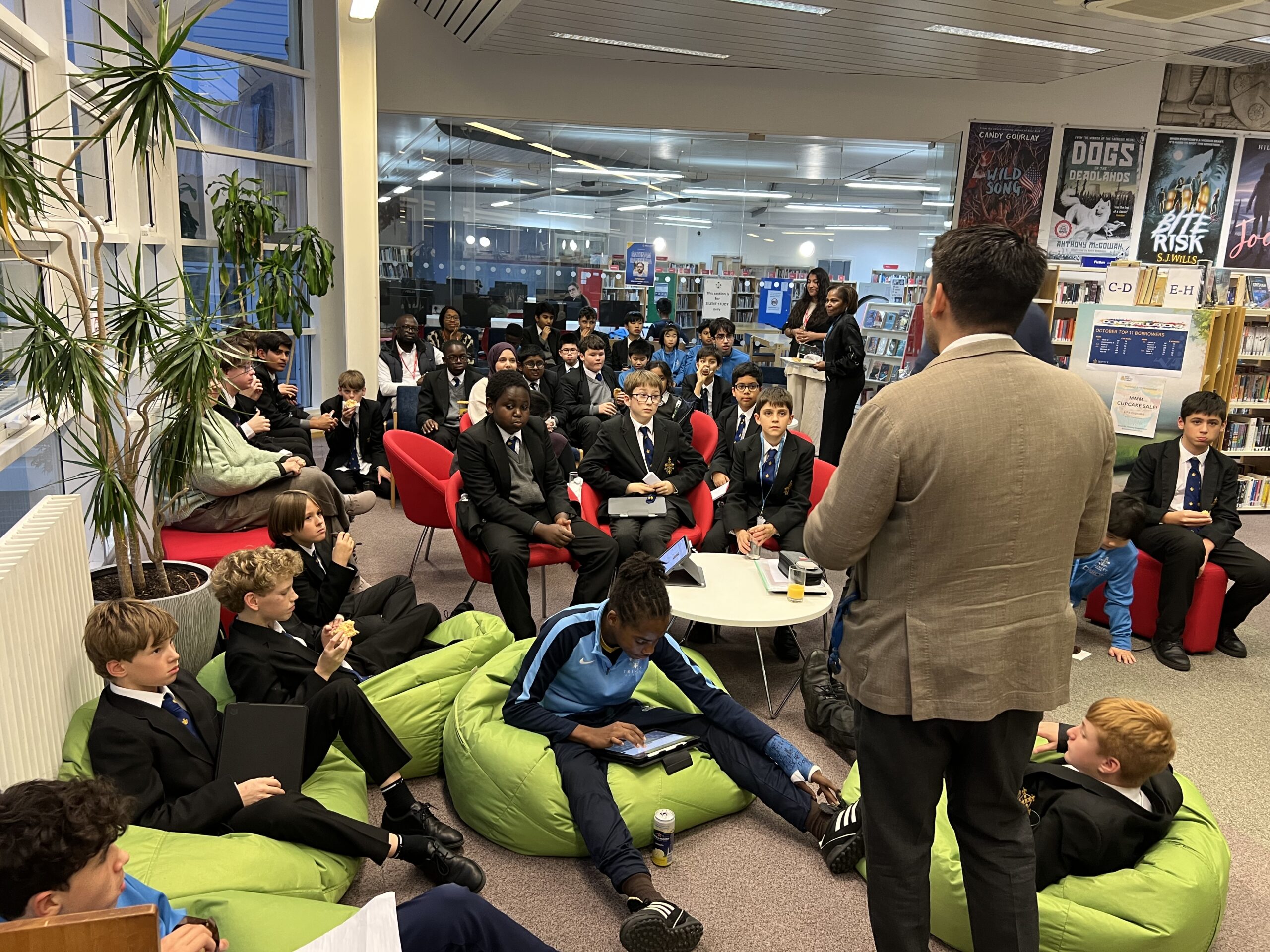
Over the past few years, poetry events in the Library have become a regular part of school life. Organised by Teacher of English Ben Goode, they give students a welcoming space to share their work.
“It’s about giving students a space to say the words they’ve written,” he explains. “There’s no sense of good or bad poetry. It’s about expression.”
Students from across the school gather after school, often alongside parents. Guest poets also perform, sharing their craft and encouraging students to develop their voices. Many leave inspired by what they hear.
During performances, students hold small clickers. When they hear a line that resonates, a quiet chorus of clicks spreads through the room.
Standing up to read a poem can take courage. “The first time I read my poem, I was literally shaking,” Keaden remembers. “But as I kept reading, I calmed down.”
Now the events are one of his favourite parts of the year. “I enjoy seeing the bravery of students as young as Year 6 delivering poems,” he says. “Their voices are raw and passionate. I’ve seen students come along to support their friends, and the next time I see them, they’re performing.”
Mr Goode agrees. “When you give young people the opportunity to use their voice and express complex feelings through a creative form, they take it.”
Inspiration and influence
Music has also helped shape Keaden’s voice. Artists such as Stormzy and Dave have influenced the way he thinks about rhythm and storytelling.
But when asked about his biggest inspiration, his answer is immediate. “Forget Stormzy and Dave,” he says. “My biggest influence is Mr Goode. I wouldn’t have started writing poetry without him.”
Their conversations about writing have become a regular part of his week. “He tells me how it is,” Keaden says. “What’s best for me and how I should approach things. He always encourages me to keep writing.”
Standing on stage
Performing in front of the whole school was a different challenge. The Black History Month assembly, led by students sharing their own poems, was the first time Keaden had read to such a large audience.
“I know my friends,” he says. “When they saw me on stage they were going to laugh. They told me afterwards they were ready to laugh. But when they heard what I said, they appreciated it.
“I was happy that I didn’t let fear stop me,” he says. “I read it with confidence.”
A wider platform
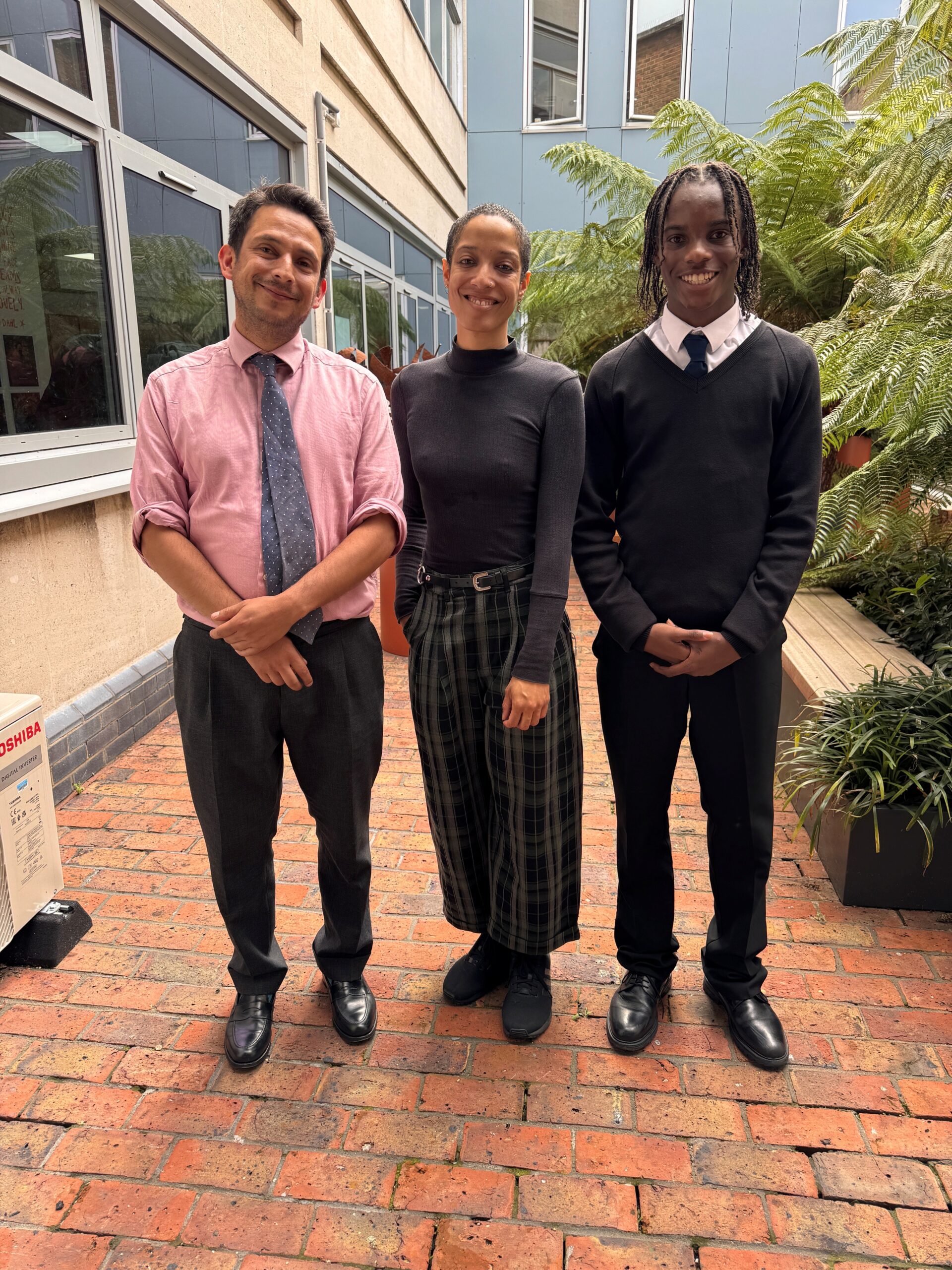
Keaden’s commitment to the poetry events led to him becoming Trinity’s first Poet Laureate.
“I was honoured,” he says. “At first I wasn’t quite sure what the role would be.” After some conversations with Mr Goode and doing a quick Google search, he began to understand the significance.
“Being Poet Laureate means I now have a bigger platform. My words can reach more people.”
The role will also involve encouraging other students and gathering poems from across the school. “I’d love to work with younger students and hear what matters to them,” he says. “What matters to them might not be what matters to me.”
For Keaden, that variety of perspectives is exactly what poetry is about. “Poetry has no laws,” he says. “You write how you feel. Poetry gives a voice to the voiceless.”
Poetry on the stage
Upper Sixth student Madinah was the driving force behind making Trinity’s Black History Month assembly student-led. Writing has always been a creative outlet for her, “Poetry makes it easier to express strong emotions.”
“I felt that assemblies for Black History Month sometimes relied on pre-made presentation materials that didn’t resonate strongly with students,” she explains. “I wanted students’ voices to be at the centre.”
Instead of slides or speeches, students shared their own work. “The theme was Standing Firm in Power and Pride, and poetry gave us the opportunity to amplify our voices.”
Madinah, Keaden and Fourth Year Dami each read original poems.
“There was potential for the assembly to be nerve-wracking,” she says. “But seeing the effect our words had, not only on the audience but on each other, was powerful.”
“It showed that we can create history in the present day.”
Scroll right to see more stories