This feature originally appeared in the Spring 2026 issue of In Trinity, which focused on our key value of ‘Responsibility’.
Mr James Robertson, Director of Art
“Portraiture is one of the most fascinating and challenging areas of art we explore at Trinity. Capturing a likeness is incredibly difficult. With a landscape there is room for interpretation, but when we draw or paint a person, our eye instantly recognises when something feels right or wrong. That challenge is exactly what makes portraiture such a rewarding skill for our students to develop.
We begin introducing portraiture in the Second Year, where students learn how to observe the face carefully, studying the proportions and structure before building a full portrait. They experiment with techniques such as the grid method and create their own self-portraits, discovering how small details can transform a drawing. Later, in the Lower Sixth, students explore portraiture in three dimensions through life-size clay heads, learning again to construct the face piece by piece before bringing everything together.
What makes portraiture particularly compelling is that it goes far beyond appearance. Every portrait raises questions: how do we see ourselves, how do others see us, and how do we represent someone with honesty and care? As our students develop their own projects, portraiture often becomes a way to explore identity, relationships and personal experiences.
That also brings an important sense of responsibility. When we create a portrait of another person, we are not simply recording what they look like. We are interpreting who they are. Our students think carefully about how they represent their subjects and the stories behind them, balancing artistic expression with respect for the individuals they depict.”
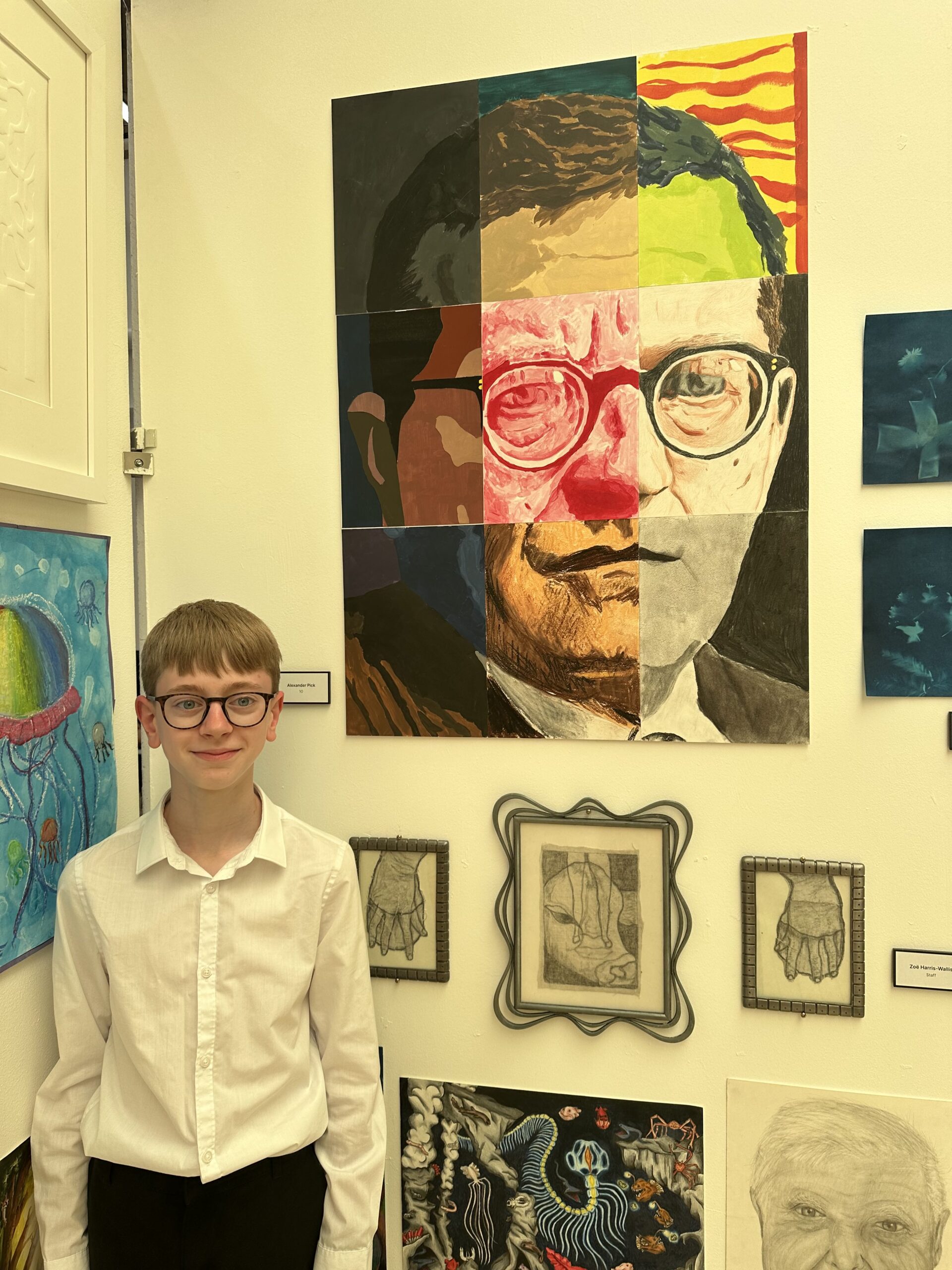
In this feature, we are delighted to showcase several examples of portraiture from across the school, from an award-winning younger artist to A Level students whose work demonstrates the depth, skill and thought that portraiture can inspire.
Ananya Rammohan (Class of 2025)
For her A Level coursework, Ananya produced a portrait of her grandfather. She says, “The portrait was inspired by the metaphorical ‘gap’ between generations. I wanted to capture a moment where this distance, despite age, felt at its smallest, focusing on the idea of birthdays and how they take on greater meaning later in life.
At the time, my grandfather was ailing, and his 83rd birthday became the subject of my piece. It marked an important moment for our family as we celebrated another year with him.
Creating the painting felt emotional, but also very special. I was able to preserve that moment in time and now, after his passing, having this painting as a memory of him is something I will always be thankful for. It means even more to me that he was able to see the finished piece.
I have always been interested in portraits, from sketching characters on book covers to working more seriously with oil paints. I especially enjoy discovering the subtle colours within skin tones, although capturing emotion remains one of the most challenging and rewarding aspects of portraiture.” 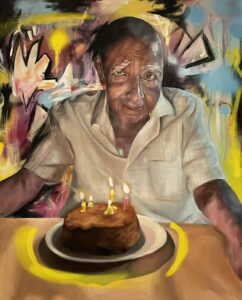
Lauren Izbicki (Class of 2025)
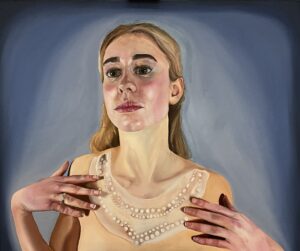
Lauren studied Art A Level and a key piece of her coursework was a large portrait of her friend Annabel.
“It is based on the female gaze. I wanted to create a piece that challenged the male gaze, instead controlling how the viewer sees the woman in the painting. I did this by working on a large scale, inspired by Jenny Saville. The beaded skin on her chest represents spots and boils, but they appear as a pearl necklace, bringing power to our imperfections and showing how they can be seen as beautiful.
This was my first portrait and was a big challenge, as I usually paint in minuscule detail. I had to enhance the colour to capture the life and beauty within natural skin, which I found difficult but rewarding. I enjoyed the process, although I would probably approach it differently next time.
I loved my time studying Art A Level; it was my favourite part of the day. I have always had ambitious ideas for my work, and my teachers were amazing at helping me realise them. Whilst I haven’t applied for an art degree, I may return to study art in the future, and I will definitely continue painting. Art is a nice escape and a joyful skill I hope to never lose.”
Jamie Hung
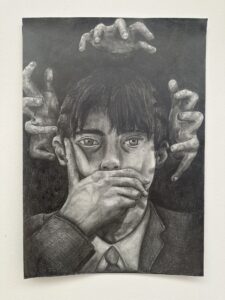
Third Year Jamie is an Art Scholar and was the overall winner of last year’s Open Art Awards. He submitted a striking pencil-drawn self-portrait, exploring the theme of anxiety around exams.
Talking about his self-portrait he said, “Although I’d started this piece earlier in the year, it wasn’t until we started doing portraiture in our Art lessons that I really developed it. During this time, it was end of year exams and there was a lot of anxiety around them, so I decided to incorporate that theme into my art to shed light on how intense this pressure can be.
“I enjoy portraiture as it does not always require deeper meaning or complex themes; when you get it right, portraits can really capture the essence of a person and their emotions. Most of my portraits are of people that I admire, like the one I did in Year 6 of David Attenborough.”
Workshop with Francis C. Kelleher
We connect our students with professional artists wherever possible to mentor and inspire. Recently, we welcomed fine artist and alumnus Francis C. Kelleher (Class of 2007) to run a portrait workshop with our Art Scholars from across the school. Jamie said, “It was really helpful to understand Francis Kelleher’s process for creating his artwork; he showed us that to capture a person in a painting you need to draw them as a whole rather than focusing on a part of their face or body.”
The students were tasked with drawing their teacher Mr Coma, which for some was a challenging task. Jamie said, “Mr Coma is someone we see all the time, so we know his face already very well. However, this made it harder to draw him as you notice all the details of his face, his personality, or his demeanour that you haven’t quite got. There was, of course, also a desire to ensure that Mr Coma was done justice in the picture, but Mr Kelleher did really help guide us in what to focus on.”
Scroll right to see more stories