


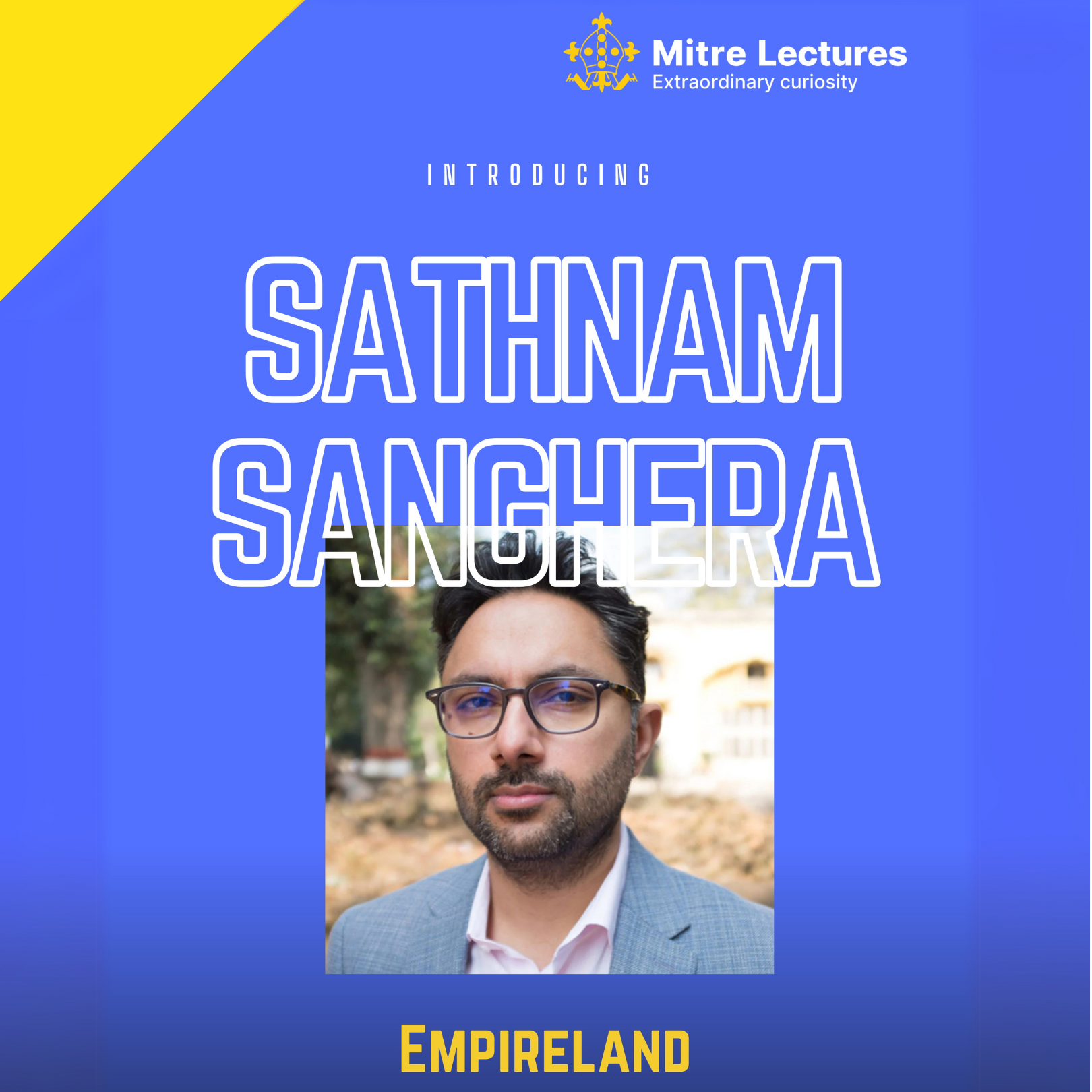
We recently welcomed the acclaimed journalist and author Sathnam Sanghera for our final Mitre Lecture of the academic year. The author of Empireland and the forthcoming sequel Empireworld, both of which narrate the complex influence and legacy of the British Empire, Sathnam spoke with great authority, sensitivity, and humour about the role of the Empire in shaping modern Britain and its former colonies.
Drawing on his own experiences growing up in a non-English speaking household in Wolverhampton, he urged our students to look beyond the binary, reductive debates over whether the Empire’s legacy should be remembered positively or negatively, encouraging them to enrich their understanding of the contemporary world by investigating Empire’s influence in their areas of interest and experience. In a wide-ranging lecture that captivated the 100-strong audience of students from First Year to Upper Sixth, Sathnam covered the legacy of enslavement and indentured labour, imperial brutality in Ireland and Australia, and Empire’s continuing influence on medicine, technology, and debates about immigration and culture.
Lower Sixth Politics students Adil and Madinah then chaired an outstanding Q&A session in which Sathnam fielded questions from students about neocolonialism, the question of imperial exhibits in British museums, fundamental British values, and multiculturalism.
Madinah said, “Concluding the Mitre Talk cycle for this academic year by conducting the Q&A alongside Adil, with fellow Sixth Former Katy introducing Sathnam Sanghera, was a wonderful experience. Having read his book Empireland prior to his talk, it was fascinating to hear him explain his thought process while writing and what spurred him on to approach this topic in the first place.
“It was eye opening to find out how much empire once influenced Britain and how the surviving influences are felt more acutely in independent schools like our own. The topic of empire and imperialism is often at the heart of many conversations regarding immigration and contemporary British culture, and Sanghera argues in favour of Britain’s multiculturalism and states that with the legacy of an empire like the British’s, diversity is inevitable.
“His response to my questions covering the subject matter of British values and the recent influx of appropriating south Asian culture were thought provoking. Sanghera’s book makes for an enticing read that is not verbose but easily understood and very accessible—I highly recommend.”
Sathnam’s lecture marked the end of the Mitre Lectures’ inaugural year, which has also included lectures on everyday sexism by Laura Bates and on counter-terrorism law by Sultana Tafadar KC. We look forward to welcoming leading figures from the worlds of medicine, politics, technology, and literature as part of the 2025/26 Mitre Lectures’ programme.
Scroll right to see more stories


