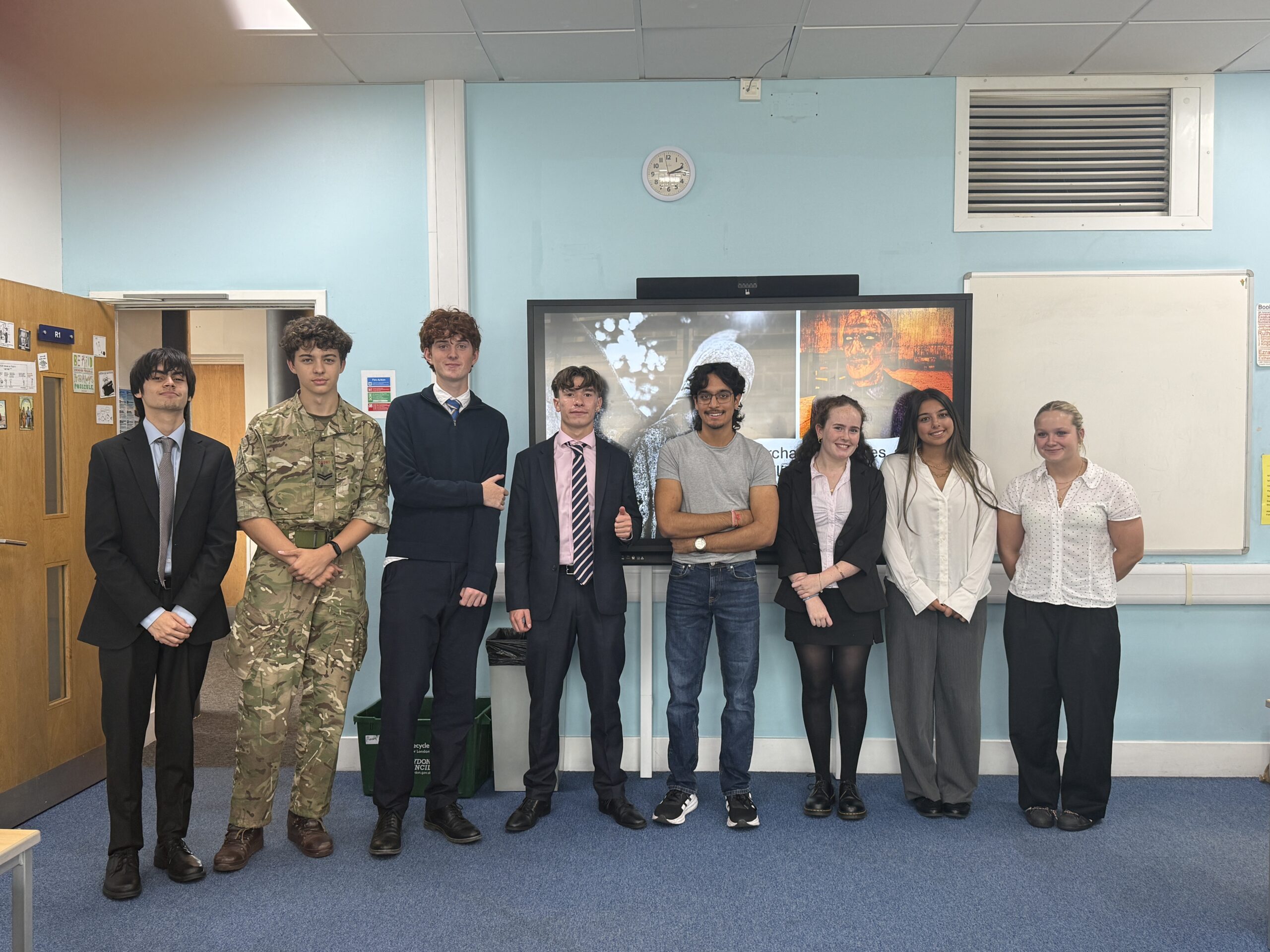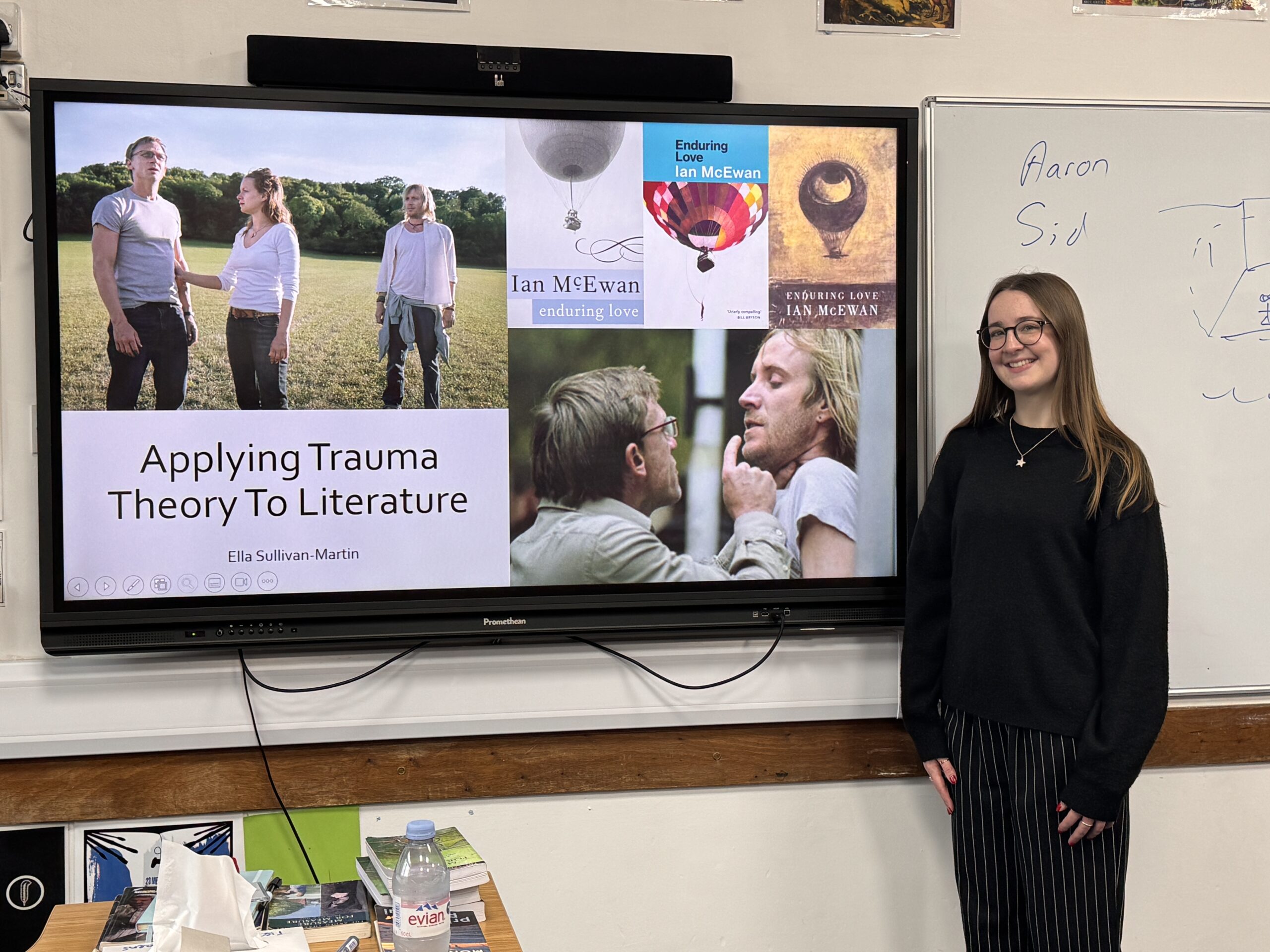
Trinity’s Literary Society (LitSoc) was delighted to welcome back former student Ella Sullivan Martin for a thought provoking and engaging talk, Applying Trauma Theory to Literature. Ella shared insights from her own academic journey and recent dissertation research, showing how trauma theory can open up new and powerful ways of reading texts.
Ella left Trinity in 2022 with outstanding results in English Literature (A*), Religious Studies (A) and Psychology (A), as well as an A* in her EPQ, awarded full marks. She went on to study English at the University of Bristol, graduating in 2025. Her dissertation The psychopathology of romance’: A study of trauma and erotomania in Enduring Love, formed the foundation of her talk.
Introducing our students to key thinkers in trauma studies such as Sigmund Freud, Cathy Caruth and Laura Brown, Ella explained how their ideas shaped contemporary approaches to literature. She explored the relationship between memory, psychology and narrative, and how these elements influence the way stories are told and understood.
The central focus of the session was Ian McEwan’s Enduring Love, the 1997 novel later adapted into a film starring Daniel Craig and Rhys Ifans. Ella examined the psychological complexities of erotomania through the character of Parry, highlighting how his obsessive behaviour is captured in Joe’s reflection that, “every gesture, every word I spoke was being stored away”. She also discussed Joe’s own psychological unravelling, quoting, “he was on my lips, on my mind… to such an extent that I had forgotten that he was out there, a physical entity”.
Looking beyond McEwan, Ella encouraged students to apply trauma theory to a wider range of texts, including Lolita by Vladimir Nabokov and Virginia Woolf’s Mrs Dalloway. Students also considered how trauma appears in dystopian fiction, debating moments in 1984 or The Handmaid’s Tale and exploring Cathy Caruth’s ideas through the character of Winston, prompting a lively and thoughtful discussion.
Ella concluded by reflecting on her experience of studying English at university and how it differs from A Level study, highlighting the increased independence, deeper engagement with criticism and the value of interdisciplinary thinking.
Upper Sixth student Beni commented, “Ella’s walkthrough on her dissertation really cleared up grey areas for me, especially the reassurance around choosing a topic and working alongside an expert in the the field. It was a very encouraging insight into what studying English at university will look like over the next three years!”
Upper Sixth student Maggie also reflected on the wider significance of the session saying, “I think trauma theory demonstrates the importance of literature. Although characters are imaginary, their psychological trauma and struggles are true of someone, somewhere. Trauma theory teaches us how to sympathise with and understand people’s suffering both in and out of literature.”
We are incredibly grateful to Ella for returning to Trinity to share her expertise and enthusiasm. Her talk was inspiring, intellectually stimulating and gave students fresh ways to think critically about literature. Thank you, Ella!
…
Our programme of academic societies encourage students to think beyond the curriculum, by inviting in external speakers or alumni to share new perspectives.
Scroll right to see more stories